Polymer Projects
Polymer crystallisation
The properties of semi-crystalline polymers depend on their crystallinity and microstructure. Fillers and plasticisers are often added to enhance polymer crystallisation and processibility. We used a generic polymer model to simulate polymer crystallisation in a plasticised polymer at a filler surface.

Glass transition of polymer thin films
The shift in polymer glass transition temperature, Tg, between bulk and thin films has been the topic of much scientific debate. The glass transition can be calculated using MD simulations, however, this provides a number of challenges due to statistical variation. We have explored simulation methodologies for obtaining Tg, and and found that Tg of a thin film of polyethylene between graphene layers is higher than bulk polyethylene.

Polystyrene on gold
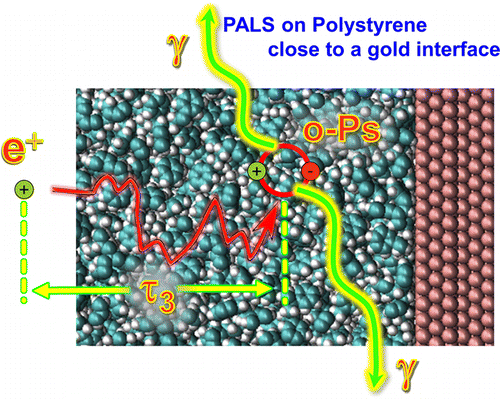
We developed a hierarchical multiscale model of polystyrene on gold to study the effect of the surface on the polymer interphase, which is the region next to a surface that has properties perturbed from bulk properties.
Butt et al. Macromol. 47 8459 (2014)
Johnston and Harmandaris, Macromol. 46 5741 (2013)
Johnston and Harmandaris, Soft Matter 9 6696 (2013)
Johnston and Harmandaris, Soft Matter 8 6320 (2012)
Johnston and Harmandaris, JPCC 115 14707 (2011)
Polycarbonate on silica
A coarse-grained model was used to investigate the properties of bisphenol-A-polycarbonate in contact with a silica surface. Surface interaction potentials were developed based on density functional calculations. Only the chain ends adsorbed. The surface slows the dynamics of the polymer at the interface by an order of magnitude compared to the bulk dynamics for the chain lengths considered.
Johnston, et al, Soft Matter 7, 6457 (2011)
Johnston, et al. Phys. Rev. B 77, 121404(R) (2008)
Johnston, et al. Phys. Rev. B 76, 85402 (2007)

Polyhydroxybutyrate
Polyhydroxybutyrate is a promising bioplastic made from bacterial fermentation. We are using molecular dynamics simulations to model oxygen and water diffusion in polyhydroxybutyrate, which is important for food packaging applications.
Middleton et al. Macromol. Theory Simul. (2025)

Alginates
Alginate is a biopolymer that comes from seaweed. It has a polysaccharide structure with two different monomer types: mannuronic acid (M) and guluronic acid (G). We are exploring how the M:G ratio and different cations affect the molecular structure.

Epoxy network formation
Epoxy fibre composites are widely used in the aerospace and automotive industries, as well as in wind turbine blades. A challenge in these composites is the adheesion of theremoset to the fibre. We have used molecular dynamics simulations to model epoxy resin at a surface. We are developing a generic polymer model to study cross-linking.

Ferroelectric polymers
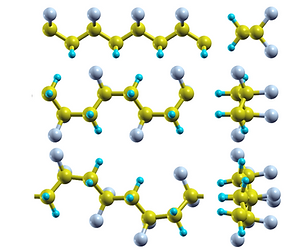
The structure and energetics of crystalline phases of poly(vinylidene difluoride) were investigated using density functional theory (DFT). In particular, we present data on non-polar analogues of the β and γ phases that have not yet been experimentally characterised.
Pelizza and Johnston, Polymer 179, 121585 (2019)
Pelizza, et al. Eur. Phys. J. Special Topics, 225, 1733 (2016)