Research
Polymers
The properties of polymer composites are dependent on the interface between the polymer and surface. We have developed multiscale models to explore how surfaces affect the polymer properties, such as melt structure, glass transition and crystallisation. We also study sustainably-sourced and compostable polymers including polyhydroxyalkanoates, alginates and chitin/chitosan. We are investigating how the addition of filler particles and plasticisers may help to improve the properties, leading to uptake of sustainable plastics in applications such as food packaging.

K Johnston and V Harmandaris, Macromol, 46, 5741 (2013)
Heterogeneous Nucleation
Nucleation mainly occurs via heterogeneous mechanisms, with the nucleus forming on a surface or interface, rather than in bulk solution. We use molecular dynamics simulations to study the composition, structure and dynamics of the solution at the interface region, which can have significantly different properties than in the bulk region.

McKechnie, et al. J. Phys. Chem. Lett. 11, 2263 (2020)
Adsorption and self-assembly
Adsorption of molecules to surfaces is important in a wide range of systems, including soft-hard matter interfaces, and self-assembly. We use quantum density functional theory to study the adsorption of molecules onto surfaces.
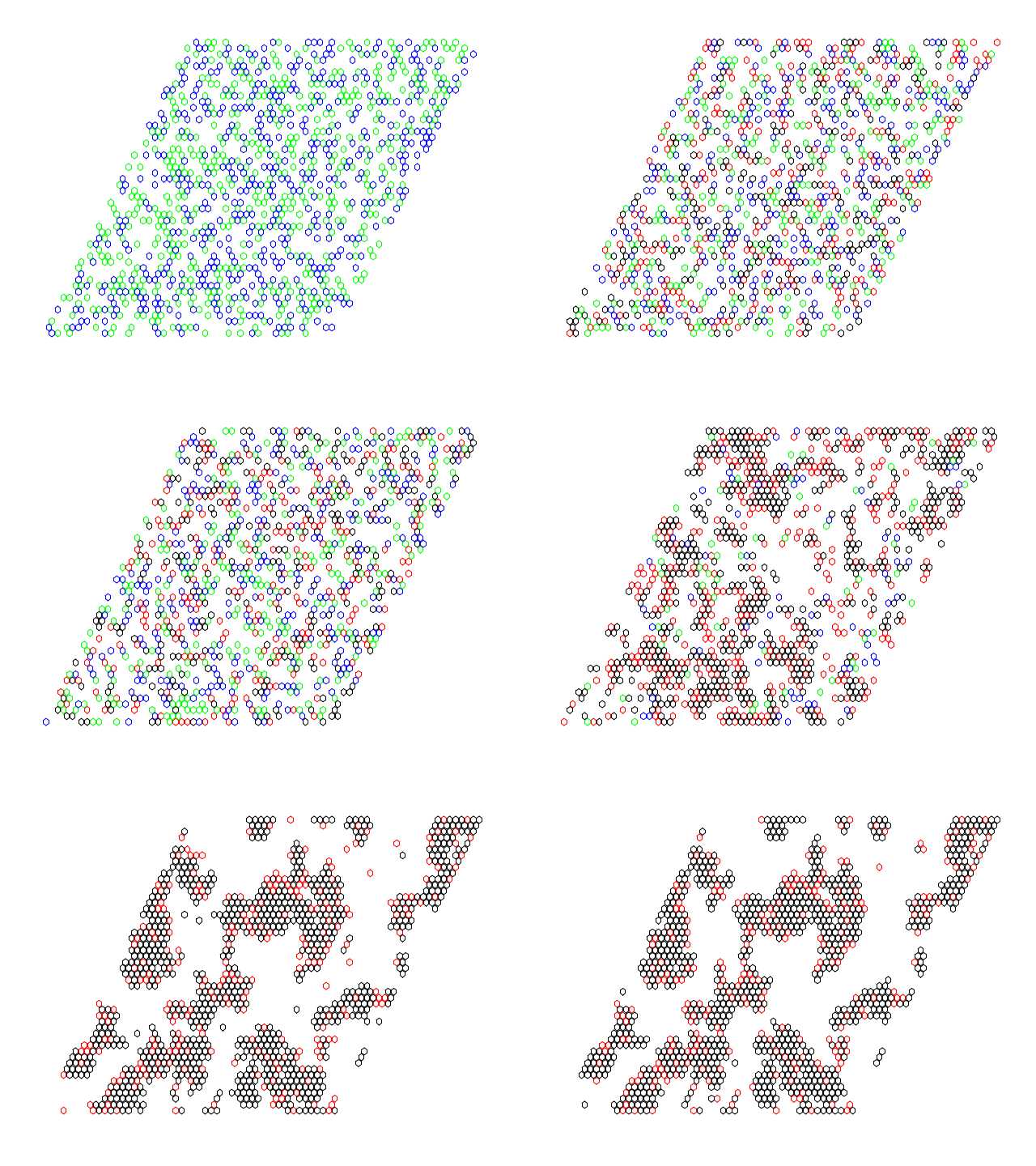
Fortuna, et al. J. Chem. Phys. 144, 134707 (2016)
Force field optimisation
To model systems using classical MD it is crucial to have a force field that accurately describes the behaviour of the system. In interfacial systems the interaction at the interface is particularly important but experimental information is not often available. We use quantum density functional theory calculations to optimise interface force fields. For crystallising systems the force field should describe both crystal and amorphous/solution phases. We validate force field to describe both phases based on available data.

Berg, et al. J. Chem. Theory Comput. 13, 5610 (2017)
Miscellaneous studies
We can provide information to help industrial or experimental collaborators to understand more about their systems. For example, calculated vibrational frequencies to help analyse IR or Raman spectra.
On occasion we pursue curiosity-driven research, such as the curdling of soy milk in coffee.

Hannah, et al. ACS Applied Materials and Interfaces 8, 25405 (2016)